A clear sign that the times are a'changin'.

You know what pozole is, don't you? And a tata is a nanny, I think.

Fresh paint. Any one for a frosty Indio?

The tradition continues..



The Austrian government has approved a bilateral pact with Mexico governing the loan of cultural artifacts, an agreement that could pave the way for a headdress believed to have been worn by Aztec ruler Montezuma II to be temporarily brought to the Latin American country.
The treaty, negotiated over nearly two years and approved earlier this week by Austria’s Cabinet, is aimed at resolving a decades-long dispute over the spectacular feather-work crown, a spokesman for Austria’s Culture and Education Ministry told Efe Thursday.
The goal is to “create international legal certainties regarding temporary loans of cultural property,” the spokesman said.
The treaty, negotiated between each country’s ministries of Culture and Foreign Affairs, does not address the matter of ownership over any cultural objects that may be loaned out, he said.
Both countries’ legislatures must ratify the treaty before it enters into effect, which in Austria’s case could occur “in a matter of months,” the spokesman said....
Under no circumstances will the Austrian government permit the headdress to be permanently transferred to Mexico, he said, adding that to his knowledge the Mexican government still has not approved the bilateral accord.
The priceless artifact, made of 400 bronze-green quetzal feathers mounted in gold and studded with precious stones, is an important Mexican national symbol traditionally believed to have been worn by Montezuma II, the Aztec emperor at the time of the arrival of Spanish conquistadors in 1519.
The headdress became part of the collection that Ferdinand II, Archduke of Austria – nephew of Charles V, Holy Roman Emperor – held at Schloss Ambras in Innsbruck, Austria at the end of the 16th century.
It was only in the 19th century that the piece was determined to be of Aztec origin.
Some Austrian experts say the feather-work crown did not belong to Montezuma II but instead was an ornamental element used by priests, although they acknowledge the headdress’ significance in Mexican culture.
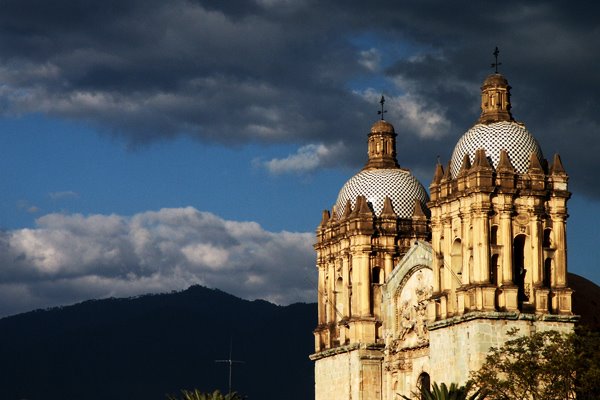
This colonial Mexican city recently received a special guest. Malia Obama, the U.S. president's 13-year-old daughter, walked through the city's elegant, ornate churches on a school field trip with 12 classmates and two dozen security guards.
Their itinerary, at the end of last month, included visits to the massive Monte Alban archeological site and the "world's biggest tree" El Tule.
The visit caused a stir. In Oaxaca, everybody seemed aware of Malia's trip — particularly the region's tourism boosters. The head of the hoteliers association attributed a recent spike in occupancy specifically to Malia. One Oaxaca promoter even joked the city should start its own "Malia was here" campaign.
The field trip gave Oaxaca what Mexico's tourism industry craves so much right now: positive press.
The bulk of Mexico's vital tourism economy comes from U.S. travelers. The country's drug war has damaged its reputation with its most frequent visitors. As a result, Mexico is trying to change perception by any means necessary.
"We believe that we have to rebrand to the Americans," said Niza Lopez, head of Oaxaca's international promotion. "Yes, there are unsafe areas in Mexico, but also there are areas like the state of Oaxaca where really there's almost no violence or crime."It is all true. Come and see for yourself


Hoy la ciudad de Oaxaca amanece como una joven de 480 veranos, por sus calles ha visto transitar hechos históricos y personajes que dejaron huella como Morelos, Porfirio Díaz, Benito Juárez, en suma: la historia de México.Please read the whole story. It is in Spanish, but this is the internet and are lots of easy ways to translate.
Today the city of Oaxaca dawns like a young person of 480 summers, through its streets, it has seen a historic journey, facts and personages left their tracks like Morelos, Porfirio Diaz, Benito Juárez, to sum up: the history of Mexico.


In September 2005, a senior Wal-Mart lawyer received an alarming e-mail from a former executive at the company’s largest foreign subsidiary, Wal-Mart de Mexico. In the e-mail and follow-up conversations, the former executive described how Wal-Mart de Mexico had orchestrated a campaign of bribery to win market dominance. In its rush to build stores, he said, the company had paid bribes to obtain permits in virtually every corner of the country.
The former executive gave names, dates and bribe amounts. He knew so much, he explained, because for years he had been the lawyer in charge of obtaining construction permits for Wal-Mart de Mexico.


Two illegal immigrants were shot to death by camouflaged gunmen northwest of Tucson in an incident evoking a pair of 2007 attacks, Arizona authorities said Wednesday.from LAHT
Nine undocumented Mexican migrants were killed and six others injured when the van they were traveling in crashed after the driver sped away from an immigration checkpoint in South Texas, authorities said Wednesday...
According to Mexican authorities, the nine dead immigrants were all men and the majority of the vehicle’s occupants had come from the southern state of Oaxaca.


