Wrong city, but right street.


 This is the Casa de Montejo located on the northern side of the zocalo. All that remains of the original construction is the façade. It was built in 1540 by the son of the first Montejo, who was defeated in his initial conquest of the Mayan.
 The sign on the front of the building says it is the best example of Plateresque architecture in Mexico. It also says that it “ displays iconographic elements allusive to the Spaniard’s conquest and domination over the Mayans, as well as references to the Montejo family, It features the sculptures of two Spanish soldiers of the 16th century, standing on individual heads with expressions of pain and terror, as well as other figures located underneath, armed with mallets. As recently as the 1980’s this house was inhabited by descendants of the Montejo family.”
 Imagine walking out on that balcony to address the assembled masses. Standing on a pile of tortured heads makes quite a statement.
 quite a striking setting with the columns and PRI curtain.
 If you look, you can see the name of the progressive politician and women's and indigenous rights advocate, Felipe Carrillo Puerto, above the stage and he has a statue in front of the building as well. A note of interest, the pre-PRI had Puerto assassinated in 1924.
 Look at the figures at the base. Those are his Mayan supporters holding him up.
 I was struck today as I continued my walking exploration of Merida. I am sure the epiphany was the result of a combination of things – heat, humidity, grit, exhaust and of course, euphoria.
 Actually, like many markets in Mexico, I think this one extended into other structures, maybe over a couple of blocks. I say this because in listening to others describe the market, it sure did not sound like the market I saw, but I digress…

 elegant and ostentatious mansions.
 So that's my epiphany - Merida is Bangkok with Mayans... and without all the golden topped temples.
 They seem skeptical.
 At the end of the day in each place, you need a shower or a swim to wash the film off.
 Opportunities abound
 Both Bangkok and Merida are big, dynamic tropical cities filled with culture and history.
 In both, there are motorcycles galore.
 And fantastic nightlife. There were concerts, dance and drama performances every night. And as in all cities, great street performers.
 And at night in Merida there seems to be a cop at every intersection keeping the traffic flowing. They really seem to have it together and other congested cities could learn a lot from this place.
 They were giving "abrazos gratis" in the zocalo in Merida yesterday. If you don't know about the Free Hugs Campaign, you should.
 There were lots of young people spread out in front of the catheral and the entrance to the zocalo, well-dressed, all smiles.
 What floored me was my reaction. Just a simple hug from a stranger in a strange city moved me to tears. Those who know me would say, "Still the same old Stowe."
 Ek Balam
 Merida - Palacio Municipal
 The Cathederal
 I love how people like to say that after hundreds of years the Mayan civilization simply faded away. They should have had breakfast with us today. Our waitress had the most beautiful classic Mayan face. They did not fade away.
 This is a modern Mayan city. They are everywhere you look.
 Yes, there is a large Spanish influence and this place has what I think is a horrible 500-year history of indigenous repression and abuse. I have some wonderful photos to demonstrate that fact that I will post later today or tomorrow. Don’t get me going…
 Again, lots of photos to post, but I want to get out and shoot, explore and drink in this place.
 After spending a few days at the ancient Mayan cities, I want to take advantage of being in a modern one.
 Not much or a preppie now, am I? Not that I ever was.
 Campeche
 Merida
 Then there are the 600 photos to go through. It’s a tough life.
 Yesterday we returned to the mixteca alta, Mixtec country, to Noxchitlan, Yanhuitlan and Teposcolula. Check out this map.
 He had given me an out of print book Week in Yanhuitlan by Ross Parmenter, former music critic for The New York Times. Parmenter describes a stay in the village he had in 1953 in which he experiences village life and spends ten days drawing and describing the Dominican church and monastery. It is a great read. See if you can find it.
 The degree and diversity of detail of the site is remarkable. Everywhere is a seal or emblem carved in stone. The highly detailed doors are all different. The windows, all different.
 It was fun to share with Henry that one had to walk a certain path to better see the details. The monks followed a daily series of prayers and services and the building was designed to enhance those moments. So if one walks counterclockwise, one sees niches and altars, but if one walks clockwise, one sees blank walls.
 Above all, the sheer size and scale of the place is amazing. One good thing the current governor is doing is pushing to make the Mixtec region a new tourist destination. It should be, for the place is unique, the landscapes breath taking and the history runs back for thousands of years.
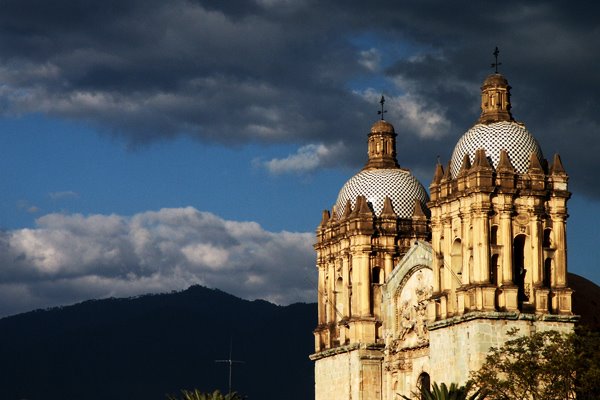
 The church was started in the 1550’s and they were newcomers. The mixteca alta has some rich history and is well worth the visit.
 The atmosphere that surrounds this church is entirely different. There is a sense of warmth that is completely lacking at Yanhuitlan. Here is a church that people still use where in Yanhuitlan the towns people basically ignore the church, choosing to attend services elsewhere.
 The decoration at Teposcolula has more whimsy, maybe a more indigenous flavor to it. Again, the stonework is impressive.
 Impressive also to see that they are restoring the church and hand carving the replacements on the spot.
 The two churches are so different. Henry offered that Yanhuitlan was all about order and authority and Teposcolua was about servicing the people and making them feel welcome.
 The Mixtec were a large and powerful nation, tough as nails, who gave the Aztecs and others real hard times. There was a need for a huge space to service such a population, but within a generation after the conquistadores invaded, that population had suffered devastation from the diseases that the Spanish brought with them. Some speculate there was a 95 percent kill rate.
 But we did make our way through the museum and nosed our way into storage areas that were full of pieces.
 While we were there, a service was taking place for someone who had died the week before. It was a follow-up to the funeral and the people left the church processed across the large open area.
 They carried flowers and a band accompanied them across the field and up the stairs, down the street to a large tent where the celebration continued long after we were gone.

