The here and now... and what and why

Complacency is a trap. At least that’s what I was thinking when I up and left the comfort of a Yankee prep school gig, where I taught music, amongst other things, for 28 years. There was also that life long career as a composer, musician and artist.

First, it was a year in St. Thomas, USVI, working as a reporter and shooting photography and then, a year in San Agustin Etla, Oaxaca, Mexico.
Time passed.
More time passed and a year back in the Athens of America followed by a hasty return to Oaxaca where it is all happening.
A couple of years in San Sebastian Etla and now, just down the road in San Pablo Etla. Life is good.

Click on an image to see it larger.
For additional photography please visit my flickr page.
You can find my music on Jango (World & latin - Worldbeat) and at iTunes and most online stores.
¡Soy consciente de todas las tradiciones del Internet!
If you are coming to Oaxaca, please contact me for tours or advice.

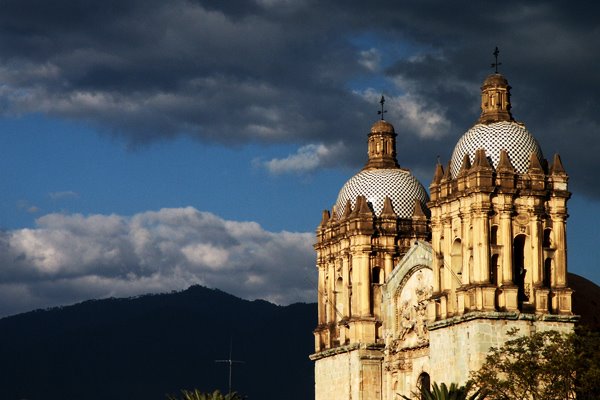
Santo Domingo

Santo Domingo
The view from Corazon del Pueblo

The hereafter re me

My photo
Oaxaca, Oaxaca, Mexico
Musician, photographer, videographer, reporter, ex-officio teacher, now attempting to be a world traveler

Tuesday, February 12, 2008

¡Dígame!

I have to practice shooting on the run, so I shoot a lot from the car while driving because there are so many remarkable sights, everything from oxen pulling carts to political demonstrations. You should see the shots I have missed – damn. So I practice.

I ain’t never seen anything like this. So you tell me…..

Thursday, February 7, 2008

El Burro

Tortillas are at the very heart of Mexican cuisine. As one who loves to cook and learn about food and its preparation, I have gotten quite an education about corn. It is a very big deal here and transgenico corn is a major political issue. There are literally thousands of varieties of corn here. In certain villages there may be as many as 26 different varieties growing, each dependent on differing amounts of sun, soil condition, etc. Having lots of different varieties helps the plants to be more insect and disease resistant.

And for those of you who have never had a real tortilla there is nothing the real thing.
I certainly have eaten my fair share of fine Mexican food in the States, but I never had a real tortilla until I came here.

It is like the peaches we used to get directly from the orchards in South Jersey. You could not even drive them home. They were so perfect and delicate even the slightest bump damaged them. They were the real peaches that very few ever get to taste. Manna from Heaven.
And that is what the tortillas I get are like. A woman in La Union makes them for me from the corn she and her family have grown. I can pick the color corn I want –white, yellow, black, blue.

And her tortillas are the best. You have to pull a bit to bite through them as they slightly tough and chewy with wonderful flavor.
The corn is shucked in a very unusual way. Normally in La Union people simply do it by hand, but here they use el burro, a ring made up of corn cobs bound together on the outside by wire.
They say they learned about it from people from Santo Domingo de Morelos Pochtla, a village near the coast and it really does the job.

Sunday, February 3, 2008

Blood sacrifice

Yesterday, my good friend Henry, in whose house I am staying and who is back in town for a week, and I went on a trek to find Apoala, the spiritual birthplace of the Mixtec nation. We were off to find the navel, a cave, from which the Mixtec believe life began.

From MexicoChannel

“Narrations of various myths on the origins of the Mixtecs, have come down to us today. According to one narrative tradition collected by Francisco de Burgoa, “their origin was attributed to two magnificent trees, proud and boastful of their branches whose leaves were stripped by the wind onto the banks of a river within the withdrawn solitude of Apoala between the mountains. This river had its source in a crevice between the two mountains... and at the foot of one of the mountains it flowed into a chasm or cave... From the veins of this river grew the trees which produced the first chiefs - male and female - who in their turn begat other beings and increased their numbers, populating a vast kingdom.”

We drove about 50 k. north on Mexico’s toll road and got off near Noxchitlan.

Henry is very knowledgeable about all things Mexican, especially its history and folk art. Well, he should. After all, he owns Amate Books, one of the best bookstores you could ever hope to visit, if you were searching for books on all things Mexico.
He suggested a trip in the opposite direction to see the 16th century Dominican church in Yanhuitlan.
Henry told a wonderfully long and involved story of the place and its ties to Spain and the Church.

The very short version: Early on, Mexico was essentially divided between three orders, the Dominicans, the Augustinians and the Franciscans. The Dominicans got Oaxaca.

When the Dominicans arrived, the Mixtec numbered almost a million and so the Church began to build an enormous structure mainly because of the richness of the place. It had the materials and a “large flock to shepherd” – a huge work force.

So the project was begun. Then disease began to take its toll. The population plummeted to 10,000, a ninety per cent kill rate. With no flock and no work force, the project was halted.

Now it is being restored. Henry said, “It’s the first place to be restored before it was finished.” So we saw it in full construction mode and had to sneak in to see the much of the church, which was filled with scaffolding and sheets of plastic. The adjoining monastery has been largely restored, but they destroyed too much of the original in my opinion. They lost much of the patina when they replaced floors and sand blasted walls. Still, it was well worth the visit for the sheer size of the structure and its amazing architecture. The flying buttresses were absolutely massive and the setting, just beautiful. There is not much out there. Some sparsely settled villages and one massive church.
We then headed back to Noxchitlan on our way to Apoala. Of course, we had to stop for food in the market.
We had an unusual dish with blue corn flattened and filled with nopales, beans and cheese. Then some special tamales for the road and we were off…

Only to discover that it was Feb. 2, Candelaria or Candlemas, the day on which people bought the Christ child from their Nativity scenes for presentation.
Candelaria is the day that the recipient of the Christ figure baked in the special sweet bread, Rosca de Reyes, on Three Kings Day needs to buy lunch (tamales) and have a party. They also have to buy the Christ child’s clothes for the following year.
So there were hundreds of people, mostly women, carrying these statues into the overflowing church.

Henry said that for that moment all of the women felt like they were the Virgin Mary with their Child. It was quite a beautiful and moving ceremony.

Eventually, we hit the road to Apoala. The road was a dry dusty one that wove its way through some very rugged country. We had to go 30 k, so Henry told me that if I went between 40 and 60 kph, we wouldn’t feel the bumps. It was a fun drive.
When we got to Apoala we learned it was the fiesta for the beginning of Carnival and the place was hopping – as much as a tiny village in desolate country can hop.

We had to register with the village and get a guide to get to the waterfalls and cave. Our guide was Oscar, a sharp and informative 10-year old.

We made our way down to the base of the falls, where there was wonderful swimming in the cold spring water.

Then we hiked back up headed to the cave, which was about a couple of kilometers downstream. Henry said he would wait behind because the place made him claustrophobic. So Oscar and I squeezed in the narrow opening and headed down into what proved to be a huge and deep chamber. He had a powerful flashlight and I could not see the end of the cave. At one point Oscar said, “Watch your head, the cave is low here.” What he should have said was, "Watch out for the razor sharp stalactites that you are about to walk into.”

Head wounds really bleed and my small cut completely freaked out the small number of people who saw me. I was covered with blood – but somehow I did not get any on my shirt and after a quick rinse, I looked better. It really was nothing and stopped relatively quickly, but it was bloody.

So there it is. I offered a healthy blood sacrifice in the cave that is the navel of the Mixtec nation. It seemed somehow fitting. I wonder if I am an honorary Mixtec now. That would be great.

Thursday, January 31, 2008

El Bautismo - The Baptism

We went to a baptism in San Felipe Tejalapam, which is just west of La Union. I am starting to realize that social celebrations here are never a one-day event. They are always at least two or three days and are an incredible amount of work. To be accurate we missed the actual baptizing of the two girls in the church as that that took place the day before, but we surely showed up for the party.
We stopped in La Union to pick up the family of Priscila, one of the girls who had been baptized and for whom we were celebrating. Somehow we managed to pack 15 people in the car and headed out on a dry and dusty road. In ten minutes, after crossing dry creek beds, we headed up an arroyo to find a large tent set up upon the side of the hills.
It was quite a remarkable setting, rugged and dramatic. The land is filled with rolling hills with mountains in the distance. It is bone dry and the air is so clear and clean that one can see for miles. Houses are very sparsely spread over the hills and yet here we were with several hundred locals.
Entrances into these events are always formal. Each family waits its turn and walks in en masse, sits together and waits before interacting with other families. Usually, there is a major domo, someone walking from table to table with mescal, so in time, things loosen up. There was a great band and lots of food and drink.
Behind the house, were two large pits in which a steer and a few goats were being barbequed.

The day before large smooth stones had been placed in the bottom of the pits and fires had been built to heat them.
The meat is placed on racks and put into the pits with large pots strategically placed to catch the juices. The whole affair is then covered with more racks, which are in turn covered with large aromatic leaves, a tarp and then covered with dirt to seal everything in.
We watched them fastidiously clean off all the layers and start pulling out large pieces of perfectly cooked meat. Goat is very common here and this was a particularly tasty recipe, real barbacoa masters at work.We just happened to be back there as they uncovered the meat and got samples before it got served. Both types of meat were absolutely delicious.
Meanwhile, the fiesta was moving on as the band cranked it up and the food was served. All the band play the same tunes, but they are all good, both the music and the musicans.
After a few hours, I looked out over the valleys and figured we had about a half hour of light left, so we had to make a quick choice of leaving or staying for the duration, which we knew was going to be very late, maybe even the next day. I was not about to try and drive out alone in the dark after all the creek beds and turnoffs we had passed on the way in. We made it back to familiar territory just as the sun went down.

The rest of the family stayed until three in the morning… and then walked back.

Tuesday, January 29, 2008

Finalmente - El Directorio

Yesterday, I visited the artesanos in La Union Tejalapam to give each of them a copy of the new directory. The municipal agencia was the first stop where we left several copies to sell to the non-existent tourists, but hope springs eternal.

If you happen to be in the area, here is the centerpiece map and believe me, it is exact.
If you are not in the area support your local artists or go online and support… me.

Actually, much to my surprise, the directory is selling much better than I thought it would. I think I am averaging one a day. I have passed out copies to friends, B&B’s and art stores and people seem enthusiastic about visiting La Union.

Here is one of the master carvers, Francisco Santiago with his great granddaughters and his copy of the directory.

Thursday, January 24, 2008

More Mexican Than Before


I had a quick trip to El Norte last week. It was time to renew my visa. These six months have gone by quickly, some of the best times of my life. Of course, sadness and problems always tag along for the ride, but I would not trade it for anything. There are wonderful memories and experiences that I will carry with me always – all part of my continuing education. Maybe I will do better in the future. I will certainly try.

I was only in the states for a few days and I had a long list of things to do and pick up.
The most important accomplishment was the printing of the directory of the carvers from La Union Tejelapam. The costs in Oaxaca were prohibitive and I worried that I would not be able to complete the project and would let so many people down, but Minuteman Press in West Newton, MA did an incredible job and the finished product is now available in local stores in Oaxaca. Now, it is on to the carvers of San Martin Tilcajete.

It was nice to walk along the frozen Charles on that same walk I had trekked so many times with so many dogs in the past.

I watched the Patriots beat San Diego with my brother and I got to experience the intense and biting cold that is New England in mid January. Of course, the Green Bay-Giants game made us feel warm. Trying to explain that level of cold to oaxaqueños is like trying to explain to a Bostonian what an avocado really tastes like right off the tree.

I also visited the school at which I taught for so many years. It was wonderful to see students, colleagues and friends. I am still sorting out the past from the present, but I think the answers are becoming clearer. Obviously, I am no longer there, but the buildings and programs I helped build still are. Watching kids in action in the Arts will give even the most cynical hope for the future. I spent almost thirty years making music and art with kids. The current generation is right on track, breathing down our necks and pushing – just like we did to those before us. Esperanza!

As I packed up my treasures for my return – Thai Hot Sauce, sesame oil, rooting hormone for plant cuttings, dormant oil for the gardenias, cheddar cheese, batteries for the G4 and video cameras, sneakers, underwear, socks, AC power cord for my MacBook, USB hubs, portable hard drives, M-Audio equipment (for the world’s most compact recording studio), books, magazine, photography gear, contact lens cleaner, crunchy peanut butter, the directory - it occurred to me that I was returning to Mexico like so many Mexicans, bringing back lots of things it is so hard to get here.

Of course, I was not like the young guy I ran into in the Oaxacan airport who had two large flat-screen TV’s with him and a few other cardboard boxes of goodies. He was the real thing and I’m just renting….

La Noche del Rabanos - Night of the Radishes

Navidad in Oaxaca is always refreshing and happy. Yes, there is some of the commercialism that so dominates El Norte, but mostly it is a relatively quiet holiday. The giving of gifts comes on Three Kings Day on January 6. El Dia de Reyes or Epiphany is the twelfth day of Christmas and we will have to see what Caspar, Melchior and Balthasar have planned for us. Officially, the Christmas season lasts until February 21 when the Nativity can be put away.
Imagine radishes as big as your arm or leg … and plenty of small ones, too. They are the staring point for one of the best days of the year in Oaxaca, La Noche del Rabanos, the night of the radishes.
As hard as it may be to believe, for 110 years oaxaqueños have been competitively carving radishes and transforming them into incredible art. Actually, the Spanish brought the radish in the 1500’s and the indigenous started carving them shortly thereafter. The first formal Noche de Rabanos in the zocalo was in 1897.
The thing I have learned from previous Rabanos is to get to the zocalo early and watch the setting up and finishing touches. Those finishing touches are often the starting touches as radish art has, approximately, a one-day life before it dries out, wilts and starts to stink – literally.
This is a competition with cash prizes and radishes are not the only medium used. In separate competitions, cornhusks and dried flowers are used to create strikingly complex and beautiful tableaus.
By the time La Noche arrives there are thousands of spectators and it is impossible to get close and really see the art. Plus, during the setup, you can talk to the artists and just watch as they do their thing.
This year Rabanos was subdued, but much more festive than last year when there were police everywhere. Oaxaca has come a long way back, but is nowhere close to where it was before the mess began.

Tuesday, January 8, 2008

Live or Blog?

That is the question. Blogging is hard work and as the blogosphere expands, its demands for time expand as well. Words are tough enough, but those photos and videos.... oh my!

For the last two weeks I have chosen to live and experience the things I will try to write about in the coming weeks. No doubt, things will be left out, either forgotten or left on the editing floor, due to time constraints. However, La Noche de Rabanos and Noche Buena were wonderful, albeit a bit subdued this year. And there was the baptism and fiesta in San Felipe Tejalapam. I will try to get caught up in the next few days.

I read a lot of blogs daily, in addition to several newspapers, and now that I am trying to blog, my admiration and respect for what the bloggers do increases. It is hard to stay current and it is even harder to post things everyday. The blogs I read seem like they are on top of things 24/7 and posting every few hours or minutes.

I guess I would put in a plug for the importance of the expanding blogosphere and its quick supplanting of the MSM or The Village. The media's ignorance and gross manipulation of the facts is really quite remarkable. I just wonder if it is as obvious to those inside the borders as it is to the rest of the planet.

As someone living outside the country, I need to get information and here in Mexico, all I have for US stuff is Fox News and CNN International.
You have no idea what the world sees and thinks of the US and if you do... well, it is pretty scary picture. So blind, arrogant and biased. Or maybe that is just me.....

From the outside, the place looks pretty bad with the economic problems, the war, the scandals, the obsession with celebs, the loss of moral standing in the world. I cannot believe that people are actually still arguing about whether or not it is ethical to torture? Or that the earth is only 6,000 years old? Wankstock? The Spears Sisters? The horserace?
I feel like saying, "It does not look like the country I knew as a boy," but instead I will recommend that you get "Back in the Day" on iTunes and you can learn how I feel about such thoughts and phrases. Boils down to the fact that every generation says something similar... but really folks, what the heck is goin' on?

Yes, the USA looks crazy from afar, but so does this place. The economic situation here is going to get worse before it gets better, but more on that as the data comes in.

Speaking of craziness, we just went through a three-day quinceñera next door. There were music and fireworks all day and all night. Incidentally, the bands here are fantastic and these guys had a sound system that was powerful and clean. You could feel the bass in your gut and they were set up several hundred meters away.

More on music later, but for now.... its back to living. I'll blog on later ... mañana o mañana.