The here and now... and what and why

Complacency is a trap. At least that’s what I was thinking when I up and left the comfort of a Yankee prep school gig, where I taught music, amongst other things, for 28 years. There was also that life long career as a composer, musician and artist.

First, it was a year in St. Thomas, USVI, working as a reporter and shooting photography and then, a year in San Agustin Etla, Oaxaca, Mexico.
Time passed.
More time passed and a year back in the Athens of America followed by a hasty return to Oaxaca where it is all happening.
A couple of years in San Sebastian Etla and now, just down the road in San Pablo Etla. Life is good.

Click on an image to see it larger.
For additional photography please visit my flickr page.
You can find my music on Jango (World & latin - Worldbeat) and at iTunes and most online stores.
¡Soy consciente de todas las tradiciones del Internet!
If you are coming to Oaxaca, please contact me for tours or advice.

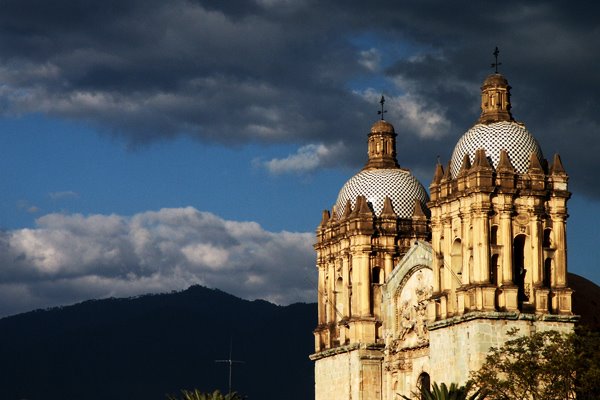
Santo Domingo

Santo Domingo
The view from Corazon del Pueblo

The hereafter re me

My photo
Oaxaca, Oaxaca, Mexico
Musician, photographer, videographer, reporter, ex-officio teacher, now attempting to be a world traveler

Saturday, April 10, 2010

Santa Ana Zegache

I am on a mission, but it is, as of yet, uncompleted. I went back to Santa Ana Zegache to try to get a decent shot of the church there with the sun shining on it's remarkable painted facade. I was there a couple of weeks ago and it was just past sunset and it was raining, but the place put a hook in me and I had to go back. Santa Ana Zegache is to the south of the city of Oaxaca and it's recently completed restoration was, in part, sponsored by Rodolfo Morales, the famous painter who lived in nearby Ocotlan. Check out the before and after pictures and read a little bit about the place.

Well, I thought I had the timing right for the light, but was, of course, exactly back-asswards. I am not satisfied with these shots, but one can see how magical this place is.Every square inch brightly painted, Painting inside the main entry arch.The interior with a spectacular retablo and wonderful wall decoration.The central dome ceiling. Amazing.The church is very hard to shoot because there are no good sight lines. Trees obscure the front once one gets inside the courtyard and shooting from outside the arch has its challenges. Here's a way to get a good shot of the front, but these guys didn't offer.
They follow me everywhere...what's up with that?

So I will head back across the large flat valley again next Monday. And I mean large, flat and fertile valley. There were people working the fields and I saw crops ready to be harvested even though we are just coming out of the dry season. There were lots of fields of roses, good looking corn, lettuce, onions, cabbage. The soil looked so rich, it was wild. And there appeared to be plenty of water. It is a real breadbasket or vegetable basket. Being in such a huge flat valley felt strange, as the norm is being surrounded by or in the mountains. The road through the valley is very rough. I picked up a couple of campesinos who were headed in the village and had a decent conversation with them even though my Spanish is still weak.

I love being stupid now after being a genius my whole life. When they got out, they asked, "Cuanto? How much? " I said, "I will only be here 15 minutes." Then I realized what they were asking and laughed. "Nada y gracias."

Thursday, April 8, 2010

Gracias, pero no - No Daylight Savings!

Mexican Indians, Teachers Oppose Time Change

OAXACA, Mexico – Tens of thousands of Indians in the southern state of Oaxaca who orient their lives around the sun have decided not to move their clocks forward one hour for daylight savings time, which went into effect on Sunday in Mexico.

Indians in 418 Oaxaca municipalities who live according to their own “uses and customs” have maintained this position for the past 14 years, saying the time change is imposed on them without their consent and brings them no benefits, different indigenous spokespersons told Efe on Tuesday.

Some 3.8 million people live in Oaxaca’s 570 municipalities, 70 percent of whom are Indians belonging to 16 ethnic groups.

“We use God’s time here, not the government’s,” one Indian in the Oaxaca town of Magdalena Jaltepec, part of the Mixtec region, said when asked why his people refuse to move their clocks forward like the rest of the country.

Wednesday, April 7, 2010

Velas de concha - Candles from Teotitlan del Valle

For years I have admired the amazing candles I have seen in the church at Teotitlan del Valle. I finally found one of the families that makes them and ordered a couple of large white beauties. Actually, it was no too hard to find the Vasquez family. It must have been that large sign in front of there place on the the main drag, Av. Juarez No. 84. How could I have missed it before?
It took a couple of weeks for them to be done, but it was Semana Santa and they were very busy as you can imagine. Well worth the wait. don't you think? The flowers, rosas y callas, are all wax and it was hot today, so it was the first time I used the AC in the car. They were happy and so am I.

Tuesday, April 6, 2010

PSA

Public service announcement the Teotitlan del Valle way.

Sunday, April 4, 2010

Semana Santa - Holy Week


"Celebraciones de Cuaresma 2010" ended today with Easter. "Cuaresma" refers to the 40 days leading into this final Sunday. Oaxaca is packed with tourists, certainly a good sign for businesses. There is an international look to visitors with lots of Europeans and people from the Far East wandering the streets. All of them are clutching cameras, so I fit right in. And lots of mexicanos, as well. Oaxaca is a popular destination for Semana Santa.

It was a long week. Starting with Palm Sunday in Santa Ana del Valle.To the traditional callejoneada on Thursday, a moving street party with lots of musicians from the local university.There is a reason people come here. It is a festive and, at the same time, a somber week, full of rituals, celebrations and traditions. And of course, Oaxaca knows how to welcome visitors. There were food stands set up everywhere and the smells were way too tempting for most.I did the best I could, but shooting at night in large crowds is tough, at least for me. For the Good Friday "Procession of Silence" the crowds were too much to deal with. I was glad I got there early enough to get some shots because once the event began it was sardine city. It helps being a foot taller than most of the people, but having a big gringo standing in front did not endear me to some. It balances out as I try to walk under the makeshift awnings and roofs that are thrown up everywhere. I get whacked in the neck by ropes and cables all the time. Not to mention having permanent lumps in the head from smacking into things down here regularly.
Procesion del Silencio began at around sunset on Friday. Lots of iconic images. The crosses that they are carrying are quite heavy.

Many beautiful images. Some of the banners to be carried.
As I watched all the pageantry, saw all the richness and riches of the church, and having learned some of it's history in Mexico, I could not help but think of it's current problems. It was a long week.

Saturday, April 3, 2010

Buñuelos

From last night.... It doesn't get any better than this, except maybe for the taste and experience of eating them. Buñuelos come in many different forms, These are Oaxaca's version. The bowls are filled with a syrup made from sugar, cinnamon and guava (I think) and one breaks the buñuelo and dips it in the liquid. Afterwards, for good luck, the bowl is broken by throwing over one's back,

Thursday, April 1, 2010

Alebrije!! Oaxacan Woodcaving?

Alebrijes, woodcarvings, are what help make Oaxaca famous. This one looks like a typical one from either Arrazola or San Martin Ticajete.
So is this the world's largest woodcarving? Call Guiness? No, this one is paper mache and they are common through parts of Mexico. "Alebrije" means nightmare or fantasy creature.

Wednesday, March 31, 2010

Little earthquakes

From today's El Imparcial

Van 179 sismos

Comentó que no ha dejado de temblar en el estado, ya que en lo que va del año se han registrado 179 sismos, lo que da en promedio de dos sismos por día, que de acuerdo a los especialistas esto es bueno, porque libera la energía lentamente para evitar un sismo de mayor magnitud.

Meaning...

It has not stopped shaking in the state. Thus far this year, there have been 179 earthquakes registered, an average of two earthquakes per day. That, according to the specialists, is good, because it slowly releases the energy and helps avoid an earthquake of greater magnitude.

Monday, March 29, 2010

Oaxacan Restoration - Yanhuitlan and Teposcolula

No, this isn't about the roads and streets, I will spare you that. However, it is truly impressive to watch the restoration work that seems to be a constant here. Incredible progress has been made and the results are beautiful. Most of the churches I pass by have a fresh look to them with stonework replaced and the interiors cleaned and restored. I will post shots of some of the city's churches, but wanted to start with these two from the mixteca alta, about an hour north of the city in Yanhuitlan and Teposcolula.For earlier posts and more of the story check here and here.I have been visiting this fascinating area for a few years. I remember sneaking into the church in Yanhuitlan a couple of years ago. It was closed to the public and was dark, dusty and full of birds. Now, look at it.The work is really remarkable. The church is huge with very high ceilings. The scaffolding looks to be at least 25 meters high as workers restore the painting over the main altar. Plaster is painstakingly re-gilded. The work is scheduled to be completed in July. Work going on inside and out.Yanhuitlan has such an interesting history. When the Spanish arrived in the early XVI century, there were 100,00 mixtecas living there. Now, the village has less than 800 inhabitants and the church is not really used. It does have this amazing stone retablo.So Yanhuitlan is basically unused, quiet and a bit sad.
Not so in Teposcolula, where the church is also under restoration. Started at roughly the same time as Yanhuitlan (16th cent.) this church is always alive and in use. There is restoration work both inside and out proceeding at a fast clip with lots of workers. The finished organ loft. Again, this is a very large structure. The columns are probably 10 to 15 meters tall. The stonework is remarkable, all cut and fashioned on site.The baptismal font in a side chamber.Recently cleaned and restored retablo.Plus, lot at Teposcolula's Municipal center. Does your city hall look so fine?Well worth the visit. Almost no one goes to either place. Put it on your list.