The here and now... and what and why

Complacency is a trap. At least that’s what I was thinking when I up and left the comfort of a Yankee prep school gig, where I taught music, amongst other things, for 28 years. There was also that life long career as a composer, musician and artist.

First, it was a year in St. Thomas, USVI, working as a reporter and shooting photography and then, a year in San Agustin Etla, Oaxaca, Mexico.
Time passed.
More time passed and a year back in the Athens of America followed by a hasty return to Oaxaca where it is all happening.
A couple of years in San Sebastian Etla and now, just down the road in San Pablo Etla. Life is good.

Click on an image to see it larger.
For additional photography please visit my flickr page.
You can find my music on Jango (World & latin - Worldbeat) and at iTunes and most online stores.
¡Soy consciente de todas las tradiciones del Internet!
If you are coming to Oaxaca, please contact me for tours or advice.

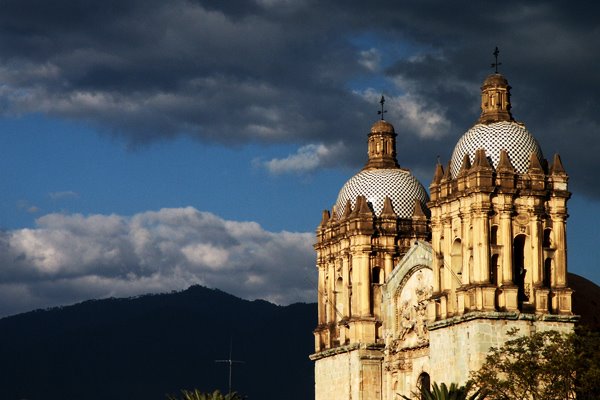
Santo Domingo

Santo Domingo
The view from Corazon del Pueblo

The hereafter re me

My photo
Oaxaca, Oaxaca, Mexico
Musician, photographer, videographer, reporter, ex-officio teacher, now attempting to be a world traveler

Friday, November 23, 2007

La Catarina


Death and how a culture thinks about it some to be at the very nub of what actually defines a “culture.” Consider the cultures you know something about. How do they deal with death?

Each significantly differently, I am sure, but how, I will never know. To really understand a culture, you must be a part of it and that is hard as an outsider.

I guess it is like my Latin piano technique, which would be better if I were born in say, Cuba. No matter how hard I work at it, well you know … I remain a gringo trying hard not to be a gringo.

Growing up in the States, we definitely have some unhealthy attitudes about death, mostly based on fear and avoidance. I think about the many deaths I have experienced, most are filled with sadness, sometimes with shock and despair.

I do not see that here. I am sure those feelings exist, but they are not as overwhelming as they are in the States. Mexico seems much different. There is an acceptance of Death here that feels right. I know that I am an outsider, an observer, but this culture thinks about Death in a much more effective and efficient way. It’s a part of everyday existence. La Muerte is always with us. Why not be friends? After all, we are all going. I like that Death has a dog, too.
And for El Dia de los Muertos, Oaxaca invites everyone to have a shot of mezcal to celebrate his or her own death. Better now than never.
As I celebrated, I could not help but think what I would like to be brought to my graveside after my death. What music? What food? What flowers? I saw graves that were planted as year-round gardens. I would like that.
In truth, it’s cremation or Tibetan Sky Funeral for me. Or just cover me in honey and roll me in birdseed and put me in the backyard. I won’t care. I’ll be dead.

And that’s the point. It is a universal. It’s a club that we will all join at some point so it is probably best not to fear it, but instead accept it.

Not only accept it, but also celebrate it, get into it. There is a joy to El Dia, to love and remember the dead in our lives in only the best of ways. No tears are allowed. They say that tears make the path upon which the spirits return slippery, so no one cries. It is all done with joy in the heart. Yes, there are quiet moments of reflection and remembrances, but they are somehow still joyful and nurturing for spirits and souls on both sides.
Here is a detail of the ofrenda above.
Un milagro! I got to see my own altar .... or alter-ego.

Saturday, November 17, 2007

Teotitlan del Valle


Teotilan is a very old village with thousands of years of history and one that has steadfastly held on to ancient traditions. It is a Zapotec weaving village and one of the best places to learn and observe those traditions.

The panteon (cemetery) for El Dia del los Muertos was exceptionally beautiful and moving.


Before, Now, After

I followed El Dia from beginning to end, from the fields to the graves and plan to stay in the cycle it initiates. Every Day of the Dead is different and while I remember this past one, I am already planning for the next one.

El Dia de los Muertos gave me a much better perspective about life in Oaxaca. I have always felt that this was a special place and now I feel it even more strongly. This culture, these people, knows things that only thousands of years can teach.

Again, I recommend Charles C. Mann’s 1491 as a great read. Here is an extensive article he wrote for The Atlantic. It helps give perspective as to just how old these cultures are and how advanced they were and may still be. The chapter on Oaxaca follows the development of corn and will make you think very differently about both, the plant and the place.

The fields of marigolds and celosia (cockscomb) or as they are know here, cempasĂșchil and dragon’s claw.


As luck would have it, I happened to shoot the same grave earlier in the year during the rainy season.

The same for this grave. The top shot is from late September. Now, the soda bottle inside makes more sense.

Tuesday, November 6, 2007

Day of the Dead Dance

In San Agustin Etla, the village in which I am living, they perform an amazing, seemingly never-ending dance - actually it last two days, I think, because I left and they were still going strong. The costumes are incredibly heavy, covered with mirrors or bells. Just walking up and down the mountain roads tired me out and I only had camera equipment, so if these dancers looked wiped out, they probably are. They had been dancing for 14 hours when I found them - and eating and drinking mezcal, too. I had gone out twice the night before to find them but I did not understand that they just keep moving from house to house and the roads here are dark. I had been disappointed not to have found them, but at six in the morning th next day, I just followed the sound and here's what I found. The dancers are amazing and so is the band. Not only are they good musicians, but their stamina is unbelievable. Party on!

Monday, November 5, 2007

El Dia de los Muertos - finalmente

After coming to Oaxaca for so many years to finally experience El Dia de los Muertos was quite remarkable, an inspirational and eye-opening series of events that will take some time to process and post. I have enough material between photos and video to do an entire site on The Day of the Dead, but for now, this is the place.

As was mentioned in an earlier post, Oaxaca had great expectations for this particular El Dia, because it presented the first potential real economic surge that this state so sorely needs. It certainly succeeded in that respect as the city was filled and many businesses had the best week in almost 2 years.

There is a reason why Oaxaca is famous for its celebrations of El Dia and for those of you reading this, do yourself a favor, come and experience it first-hand, if not next year, then the year after.

The Mexicans have the right perspective on Death. I observed much in the past week that has changed me and my perceptions. To watch children playing on graves in cemeteries filled with joyful people, music, food and flowers makes one think about not only life and death and human behavior, but also about cultural differences.

Simply put, it blew my mind.

I have a whole new aspect of respect for this culture. Their attitude about Death is so much healthier than ours in the States.

Over the span of four days, I visited six different cemeteries, many people’s homes and some pretty wild village fiestas.

Under a spectacular sunset, with the mountains as a backdrop, I watched families celebrate around the graves in the weaving village Teotitlan del Valle.

In San Miguel, the large pantheon in the city, I saw an old man in a crypt seated at a beautifully set table with wine, candle and a boom box playing Chopin.

In San Antonino, in a cemetery overflowing with the most beautiful flowers, I watched as they mixed dirt and water to make an adobe paste that they spread on the graves to make a smooth surface which they then decorated with dried flowers.


In San Agustin Etla, the pueblo in which I am living, I drank mescal with the locals at seven in the morning and followed them from house to house as they danced and drank (as they had been doing for a day before I caught up with them) in incredible traditional outfits covered with mirrors and bells.
Sunrise in the mountains with an incredible band and a couple of hundred people going crazy? Not bad.

Out standing in the field was where I was when we heard another band playing across the valley in a different village. The band I was following all turned and assembled on a ledge overlooking cornfields and facing the other band, played an “ in-your-face” good morning. Yes, I did get it on tape and will post it.

And then there was the mole that Emelia Ruiz from Teotitlan made. It was a rich shiny purple black that was just perfect. One of the best I have every experienced. We had it served over fresh homegrown turkey and delicious tortillas. And, of course, Pan de Muertos, a sweet bread that comes in all sorts of designs.

And all the altars or ofrendas, one in every house and business. This large one to Frida was in the Governor's Palacio.

It will take some time for it all to sink in and process. I will keep you posted.

Monday, October 29, 2007

Medias Rojas!!!!


For all who know me and what a good athletic supporter I am, imagine me jumping around outside last night at around eleven as the final strikeout went down. Lucky, the black lab, was the only one around and she is figure skating fan, but she indulged me as I sang and danced like a maniac in the moonlight. There was a howling wind and I was so happy, that she joined in and barked and ran around the courtyard with me. I am sure the burros and cows next door thought we were loco.

I know people who went there whole lives never seeing the Sox win the World Series and here we are, twice in four years. Ain't life sweet?

Speechless?


One of my favorite quotes is “For the unenlightened, a thousand books of a thousand pages would be insufficient, but for the enlightened, one word would be too many” and maybe that is the case with the photos below. But as another of my favorites says, “fools rush in….” so if no one else will comment, I will.

People always figure out ways to express themselves, no matter how repressive the atmosphere. In the states, we have The Daily Show and Colbert. We have come to the fork in the road when we must ask, “Can a comedian do any worse as president?”

Maybe there is comedy resistance in Oaxaca, but I have not seen it, but they do have graffiti that has evolved into a high art, in my opinion. I have been taking photos of it for weeks.

These pictures are an encapsulation of life in Oaxaca right now. There is poverty and unrest, but the government has figured out a way to deal with it. It has amassed a vast collection of cans of paint in all the colors in the city, so when political graffiti appears, as it does every night, the city simply paints over it. Problem solved.


Sound familiar?

Sunday, October 21, 2007

Wednesday, October 17, 2007

Misperos


Misperos

Just came in from eating misperos. I had never heard of them before. but I happen to be living in a relatively perfect climate for them and they are in abundance right now. Actually, they have been ripening over the last two months. They are nearing the end now as the rain has become infrequent and they are drying out before fully ripening. I think the flavor may be more intense because it is concentrated.

I am a plant nut and no matter where I am I always, somewhat obsessively, try to learn as much as I can about the plants I see. I love St. Thomas because the weeds by the sides of the roads are the high-priced houseplants in Boston. If you have ever read The Secret Life of Plants you will have an idea as to the depth of my interest and caring about plants.

But I digress…

Misperos. I remember my first sighting of them. In August, they were not quite ripe. but looked like small peaches or apricots. I wondered about the wisdom of picking unknown fruit off of trees – would I get sick? - and I wondered what they tasted like.

Now I know. I walk outside and pick them regularly. The dog eats them too.

They are quite small and they have a soft skin like an apricot. I peel the skin. The dog does not. The taste (I had to go out and eat one just now) is a combination of peach and mango with a nice tartness.

They are also known as loquat or Chinese plums.

A mispero is about 75 percent seed. There are two or three large shiny brown seeds in each one. The first time I saw the seed I thought it was animal droppings. They are large and actually attractive.

There are misperos for sale in the markets. I don’t imagine they travel well. I understand that they grow incredibly well in this area. As do gardenias. It would sure seem so. They are everywhere and the trees are completely laden with fruit.

As I walk the grounds here in San Agustin, I can pick pomegranates, limes, oranges and misperos. I even picked a tangerine this morning. There is a fig tree that is looking healthy too.

In the pueblos they are harvesting the corn and preparing for the Day of the Dead.
One sees fields of marigolds being grown. It is the flower of choice for those celebrations. I will go and shoot just before the harvest.

It has not rained for days now. The dry season is coming.

Henry says it gets so dry, you never think anything will grow again.....

Sunday, October 7, 2007

A day at a palenque


A palenque is a place where mezcal is made. It is not only the still, but the roasting pits and mash vats. It is the whole process area for turning that formidable plant, the maguey, into mezcal. Mezcal is one of Oaxaca’s trademark tastes and products. It comes in many forms and flavors and has ancient origins. It is still used in rituals and shamanistic healings. Often it is offered as a part of what could be described as a formal welcome one visiting someone’s home. Mescal is also one of the traditional gifts one brings from Oaxaca, along with chocolate and tlayudas.

More about mezcal and more.

The maguey is a remarkable plant. It provided the early indigenous people many important products including, food, water, paper, needle and thread and mezcal.

Most people do not know the difference between mezcal and tequila.
Well, Oaxaqueños do!!
So do the people of the town of Tequila in the state of Jalisco, which is just to the north of Oaxaca.

The Mexican state of Jalisco makes tequila, which is made from blue agave plants. To put it mildly, there is some little pride and competition between the two states and their liquors.

The only time I have ever been scared out in the country was the time during the piña shortage in Jalsico when we came upon a huge tractor trailer in the middle of a maguey field. There were ten men clandestinely loading piñas and one look in their eyes said we were not supposed to be there and their guns suggested we leave. We complied. Mezcal and tequila are very serious business here.

As with moles, the sauces that define Oaxacan cuisine, every single mezcal is different depending on the plant, the palenque and the mezcalero. Those who know their mezcal can immediately tell if it has been bottled in large plastic bottles or in the traditional ceramic olla. The olla acts much like an oak barrel in making whiskey. It imparts a smoothness and taste that is recognizable to the knowledgeable palette.

We were with several “knowledgeable palettes” when we visited Don Ishmael, an 84 year-old mezcalero at his palenque in Santa Catalina des Minas, which is about 40 kms southwest of the city.

The palenque was not up and working, but there was plenty of work going on and plenty of mezcal. It takes seven years for maguey to mature and there are huge fields of it in various stages of development throughout the countryside. Maguey is a large and dramatic plant and when seen in the tens of thousands across a mountain valley – only in Oaxaca.

According to Don Ishmael, after the first two years, the plants are very hardy and require little work other than normal care. But there is an art to the brewing and Ishmael is one of the masters. He let us sample from various ollas. All were delicious, but strong -110 proof. There were two grades, normal and “pechuga” in which a chicken breast has been hung in the still during distillation. They say that the minute amount of fat added makes the mescal smoother, with a slightly fuller flavor. In other ollas, Ishmael has added small amounts of various fruits, each giving its own distinctive flavors to the wonderful smokey edge of the mezcal.

The fun came when it was time to purchase. I bought some for a friend who is reopening a restaurant, El Naranjo, in the city. The only way to get the mezcal out of the ollas was to siphon it off using a hose. Of course, there is a trick to siphoning that becomes more and more elusive as one tries to suck more and more air and 110 proof mezcal.

Alone in Monte Alban


Blue and green. The day we visited Monte Alban was a rare one. Crystal clear skies and the site was spectacularly green with all the rain of the last month. September is normally a quiet month in Oaxaca with schools starting there are no tourists. This is not a normal year. There are really no tourists. So we had the place almost to ourselves, To be almost alone in this large ancient city atop the mountains was surreal. The scale and grandeur of Monte Alban tell of how advanced a culture it was that created it.

The site sits high overlooking a convergence of valleys. It took hundreds of years to create. They literally took off the top of a mountain to build it. Not only did they take the top off but they created an expansive plane that would challenge modern technologies. And they did it all by hand. They did not use the wheel. It’s use was reserved for toys. Manual labor created the site originally and it created the restoration,
which has been done to the highest of standards.

I have watched workers at Monte Alban and throughout the city. I remember watching them work on restoring the museum in town. I could see how Monte Alban was built. Here were men carrying large blocks of stone on their shoulders and climbing hand-made ladders. The walls at the museum are eight meters high and are built with the same craftsmanship that one finds at Monte Alban, Mitla and the other archaeological sites.

Plus there is a remarkable sense of wonder and awe that one always feels in these spots.

Imagine being alone in Chichen Izta, Palenque or Machu Picchu. That was the day we had in Monte Alban.

The infrared photo is by Sonya.