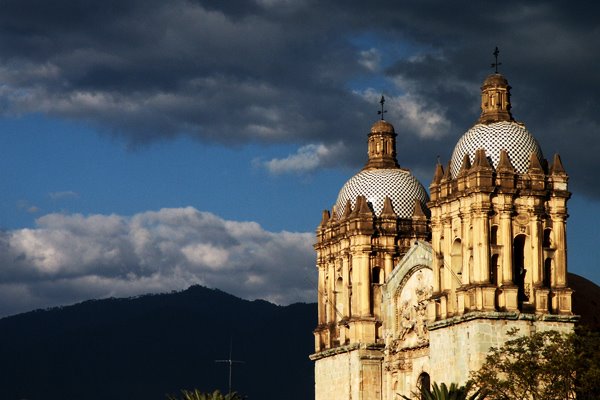

 One of the games we enjoy playing is the, "Where would you put this on your top 50 things to see or do in Oaxaca," game. Things shift around depending on where we are and what we are doing. When we are eating in the "Comedor Colon" in Etla, it always moves up into the top five. There are so many great choices for the list. Where do you put El Tule? or Monte Alban? Teotitlan? the church in Ocotlan? Santo Domingo, the mercado Merced? or market day in Tlacolula?
Clearly, Zapotitlan and the cactus forests are right up there, but for me, I keep returning to Yanhuitlan, which has a special hold on me. I think it is because, not only is it a spectacular site, but the story behind it contains so many lessons.
 The short version - in pre-columbian times, the Mixtecs lived there in the hundreds of thousands. It is very rugged land and the Mixtec were and are a tough people. When the Spanish showed up in the XVI century, they divided Mexico between the Dominicans, the Franciscans and the Augustinians. The Dominicans got Oaxaca and Yanhuitlan. They had grand plans to convert the Mixtecs and designed a huge church and village complex complete with aqueduct that stretched for several kilometers. Unfortunately, after starting construction in the early 1520's, within fifty years, disease had wiped out the population with a 95% kill rate. Yanhutlan became a ghost town, but the church remained and construction continued. Over the years, there were revolutions and purges, but the church remained and construction/restoration continued and continues today.
 Today, there are 780 people that live in the village.
When we were there last week, there were well over a hundred people working on the site.
 There are ten in this shot and this was the small stone-working area. Some people were grooming the grounds, some were cleaning steps and floors, but the vast majority were doing serious stonework on the exterior.
  This piece will go on the roof. The groove on the bottom will face up and act as a channel for water. This worker is opening up a long-sealed window in the lower front of the monastery.
  In the interior, the delicate work of restoring the paintings and retablos continues.
 The progress has been amazing, but it is a huge undertaking.
 The place is so huge. I outlined a person in this photo to show the scope and scale of the work.
 The retablos look small, but they are probably ten meters tall.
 The completed organ restoration. I don't know if it plays, but it sure looks beautiful.
 Gilded plaster pieces waiting to be installed.
 Praying for an on-schedule July completion.
 Incidentally, the spots on her face are tears of pearl or silver.
A sublimely graceful supporting arch.
 The entryway ceiling.
  Look at the exquisite detailed woodwork.
 The doorway leading from the church into the abutting monastery, You can see that the walls were all probably previously decorated with painting.
 I plan on returning every month or so to take in the progress. The place never fails to blow my mind. Top ten? Claro que si!


